What Does Home Insurance Cover? Imagine waking up at 2 a.m. during a powerful winter storm. You hear a loud crack outside. When morning arrives, you discover that a large oak branch has fallen through your roof. Rainwater is already coming into the bedroom.
You call your insurance company expecting the damage to be covered. But then the adjuster starts asking questions. What caused the damage? Was the roof damaged first? Did the water enter because of the storm or because of an existing problem?
That is when many homeowners discover something important about home insurance. Having a policy does not mean every problem with your house is automatically covered.
A standard homeowners insurance policy generally protects your home’s structure, your personal belongings, certain additional living expenses, and your liability when you are legally responsible for someone else’s injury or property damage. At the same time, policies usually exclude important risks such as flooding, earthquakes, normal wear and tear, and certain maintenance problems.
The exact answer depends on your insurer, state, policy form, coverage limits, deductibles, and optional endorsements.
This guide explains what homeowners insurance generally covers in 2026, what it usually does not cover, and which coverage gaps are easy to overlook.
Quick Answer: What Does Home Insurance Cover?
Homeowners insurance generally covers four major areas of your financial life: the physical structure of your house, your personal belongings, certain extra living expenses after a covered loss, and your personal liability.
Your house can include the roof, walls, floors, cabinets, and permanently attached fixtures. Your personal property can include furniture, clothing, electronics, and other belongings. If a covered disaster makes your home temporarily unlivable, additional living expense coverage may help with qualifying extra costs.
Liability coverage works differently. It can help when you are legally responsible for another person’s injury or damage to their property.
However, coverage always depends on the cause of the loss and the language in your policy. A sudden pipe burst may be covered, while a slow plumbing leak that caused damage over several months may not be.
That difference is one of the most important things to understand before you ever need to file a claim.
The 6 Main Coverages in a Standard Homeowners Policy
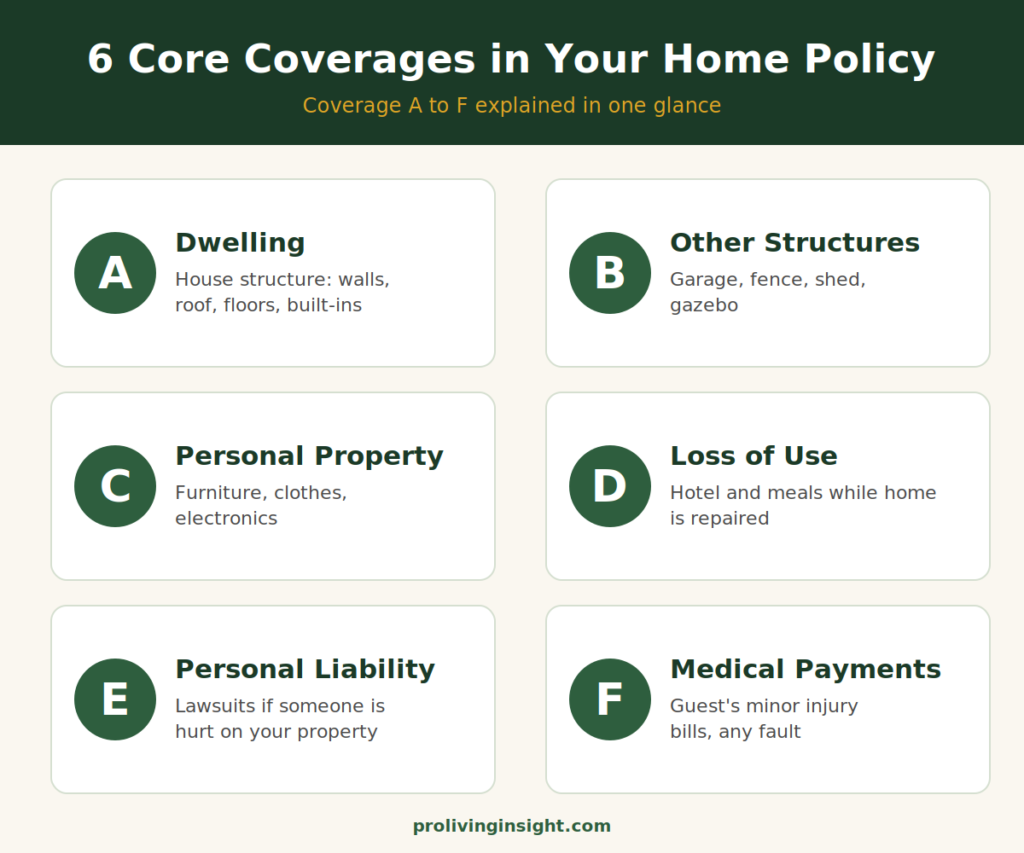
Many standard U.S. homeowners policies are organized around six basic coverage categories. These are commonly identified as Coverage A through Coverage F.
The exact limits and conditions can vary, but understanding these six categories gives you a useful starting point.
Dwelling Coverage — Coverage A
Dwelling coverage protects your home’s physical structure when a covered cause of loss damages it.
This can include the roof, exterior walls, interior walls, floors, ceilings, permanently installed cabinets, built-in fixtures, and an attached garage. If a covered fire seriously damages your kitchen, for example, dwelling coverage may help pay for repairing the structural components and permanently attached features.
Your dwelling coverage limit is one of the most important numbers in your policy.
It should generally be based on the estimated cost to rebuild your home rather than its market value. Those two numbers can differ widely because market value includes factors like land and location, while rebuilding costs focus on construction, labor, materials, and related expenses.
Other Structures—Coverage B
Coverage B generally applies to structures on your property that are separate from the main house.
A detached garage is a common example. A shed, gazebo, or certain types of fencing may also fall under this coverage.
Many policies set the limit for other structures as a percentage of the dwelling coverage, although the exact amount depends on the policy.
This becomes important if you have made expensive improvements outside the main house. A large detached garage or custom structure may be worth much more than the standard limit provides.
Personal Property — Coverage C
Personal property coverage protects many of the things you own.
Furniture, clothing, televisions, computers, kitchen items, tools, and other household belongings can fall under this category when they are damaged or lost because of a covered event.
Your personal property coverage may also apply while your belongings are temporarily away from your home. For example, certain theft losses involving a laptop while you are traveling may qualify under the policy.
But there is an important catch.
Certain valuable possessions can have special sublimits. Jewelry, watches, collectibles, fine art, coins, and other high-value items may not receive the same level of protection as ordinary household belongings.
If you own something particularly valuable, check whether it needs separate scheduling or an endorsement.
Loss of Use — Coverage D
A serious covered loss can leave your house temporarily unlivable.
That is where loss-of-use coverage, also called additional living expense coverage, can become important.
Suppose a covered fire makes your home unsafe and you need to stay somewhere else while repairs are completed. Your policy may help pay certain additional expenses associated with living elsewhere.
These expenses can include temporary accommodation and certain increased food, laundry, transportation, or other necessary costs, depending on the policy.
The important word is “additional.” The coverage is generally intended to address expenses above what you would normally spend.
Your policy will also have limits and conditions, so do not assume every expense will automatically be reimbursed.
Personal Liability — Coverage E
Personal liability coverage protects you from certain financial consequences when you are legally responsible for another person’s injury or property damage.
Imagine a visitor slips on your property and suffers a serious injury. If you are found legally responsible, your liability coverage may help with covered legal expenses and damages, subject to the policy’s limits and exclusions.
Liability coverage can also apply to certain situations where you or an insured family member accidentally damage someone else’s property.
This part of homeowners insurance is easy to overlook because it does not protect the physical house. Instead, it protects you from potentially expensive claims involving other people.
Medical Payments to Others — Coverage F
Medical payments coverage is designed for certain minor injuries suffered by guests.
Unlike personal liability coverage, it generally does not require you to be legally responsible for the accident.
For example, a guest could trip inside your home and need medical treatment. If the situation qualifies under your policy, medical payments coverage may help with the resulting medical expenses up to the policy’s limit.
The limits are usually much smaller than liability limits, and the coverage is not intended to replace personal liability protection.
What Does Home Insurance Cover Inside the House?
Homeowners insurance usually does not organize coverage by room. Instead, the policy looks at what was damaged, what caused the damage, and whether that cause is covered.
Still, looking at common areas of a house makes the concept much easier to understand.
Kitchen Damage
A kitchen contains both parts of the house itself and personal belongings.
If a covered fire damages the walls, cabinets, or permanently installed components, dwelling coverage may respond.
Movable appliances and other belongings may fall under personal property coverage, depending on the circumstances.
But an appliance that simply breaks because it is old is generally not covered by ordinary homeowners insurance. Home insurance is designed primarily for covered unexpected losses, not routine breakdowns or maintenance.
Bathroom and Plumbing Damage
Water damage can be one of the most confusing areas of homeowners insurance.
A sudden and accidental pipe failure may result in covered water damage. A slow leak that continues for months is a different situation.
For example, imagine a pipe behind a wall develops a small leak. The homeowner does not notice it for six months, and mold and structural damage eventually develop.
The insurer may treat that situation very differently from a sudden pipe burst that floods the bathroom overnight.
The source of the damage also matters. Even when resulting water damage is covered, the deteriorated or defective component that caused the problem may not be covered.
Roof and Attic Damage
Roof damage is often covered when it results from a covered peril such as certain wind or hail events.
However, homeowners should pay close attention to the roof’s age and condition.
Insurance generally does not pay to replace a roof simply because it has become old. Depending on the policy and circumstances, depreciation can also reduce the amount paid for an older roof.
Some policies may also have separate deductibles for wind or hail damage.
If you live in an area where severe storms are common, understanding that deductible before a storm hits is extremely important.
Basement and Garage Damage
Basements and garages can contain expensive property, but coverage depends heavily on what caused the damage.
Fire, theft, and certain sudden water losses may qualify for coverage.
Flooding is different.
If heavy rainfall causes outside water to enter and flood your basement, standard homeowners insurance generally does not cover the resulting flood damage. Separate flood insurance may be necessary.
Sewer or drain backup can also be excluded unless you have purchased additional coverage.
Bedroom and Living Room Damage
Furniture, clothing, televisions, computers, and other belongings in bedrooms and living areas can generally fall under personal property coverage when damaged by a covered peril.
But again, valuable possessions deserve special attention.
A standard policy may cover an ordinary television without much difficulty while applying a much lower special limit to expensive jewelry or collectibles.
The total personal-property limit does not necessarily mean every category of property is covered up to that full amount.
What Does Home Insurance Cover Outside?
Home insurance does not necessarily stop at your front door.
Certain outdoor structures, landscaping, and belongings can receive coverage. But the rules can be more restrictive than many homeowners expect.
Trees and Landscaping
Trees, shrubs, and plants may have limited coverage when damaged by certain covered causes.
That does not mean your entire landscape is insured against every storm or environmental problem.
There may be limits on how much the insurer will pay for individual trees or plants and how much it will pay in total.
For example, a mature tree that cost thousands of dollars to establish may not be replaced for its full value after a covered loss.
The reason for the damage also matters.
Fences, Sheds, and Detached Garages
Detached structures are generally handled under other structures coverage.
If a covered fire or storm damages a detached garage, shed, or eligible fence, the policy may help pay for repairs or replacement, subject to the applicable limits and deductible.
This is why homeowners should review their Coverage B limit after making major outdoor improvements.
Decks, Patios, and Outdoor Furniture
An attached deck may be considered part of the dwelling.
Movable outdoor furniture and certain other belongings may instead fall under personal property coverage.
A patio, grill, furniture set, or other outdoor item may have different treatment depending on whether it is permanently attached, movable, and what caused the damage.
The policy wording is more important than simply knowing where the item is located.
Pools and Trampolines
Pools and trampolines can create additional liability concerns.
Insurers may have specific underwriting requirements or safety conditions for these features. Some may require appropriate fencing or other safety measures.
If you add a pool, trampoline, or similar feature to your property, tell your insurer.
Failing to disclose a significant change to the property can create unnecessary problems when you need to make a claim.
What Happens When a Tree Falls?
A fallen tree can create several different insurance questions.
Suppose a strong wind knocks a large tree onto your roof. If wind is a covered peril under your policy, the resulting damage to the roof may be covered.
Some policies may also provide limited coverage for removing a fallen tree when it damages a covered structure.
But the situation changes if the tree falls into an empty part of your yard and damages nothing.
In that case, the cost of removing it may not be covered, or the policy may provide only limited coverage.
Ownership of the tree can also become relevant, but it does not automatically determine who pays. The circumstances of the loss, the damaged property, and the applicable policies all matter.
If your neighbor’s tree falls onto your house during a covered storm, your own homeowners insurance may potentially respond to your covered property damage.
Covered Perils: What Actually Triggers a Claim?
Insurance companies use the word “peril” to describe a cause of damage.
A policy may cover certain perils such as fire, lightning, windstorms, hail, theft, vandalism, smoke, falling objects, or certain sudden and accidental water losses.
However, homeowners should not rely on a generic internet list to determine whether their own claim is covered.
Your policy controls.
Two homeowners could experience similar damage but receive different coverage outcomes because their policies, deductibles, endorsements, exclusions, or circumstances differ.
Named Perils vs. Open Perils
Homeowners insurance can use different approaches when determining what causes of loss are covered.
A named-perils policy covers the causes specifically listed in the policy. If a particular cause is not included, it may not be covered unless another provision applies.
An open-perils policy takes a broader approach. It generally covers causes of physical loss unless the policy specifically excludes them.
| Feature | Named Perils | Open Perils |
|---|---|---|
| Coverage approach | Covers causes specifically listed | Covers causes unless excluded |
| Overall scope | Generally narrower | Generally broader |
| Common application | Often used for personal property in some policies | Often used for dwelling coverage in some policies |
| What matters most | Whether the cause is listed | Whether an exclusion applies |
Many homeowners policies combine these approaches.
That is why simply knowing that you have an HO-3 policy is not enough. You still need to understand the policy’s exclusions, conditions, limits, and endorsements.
What Does Home Insurance NOT Cover?
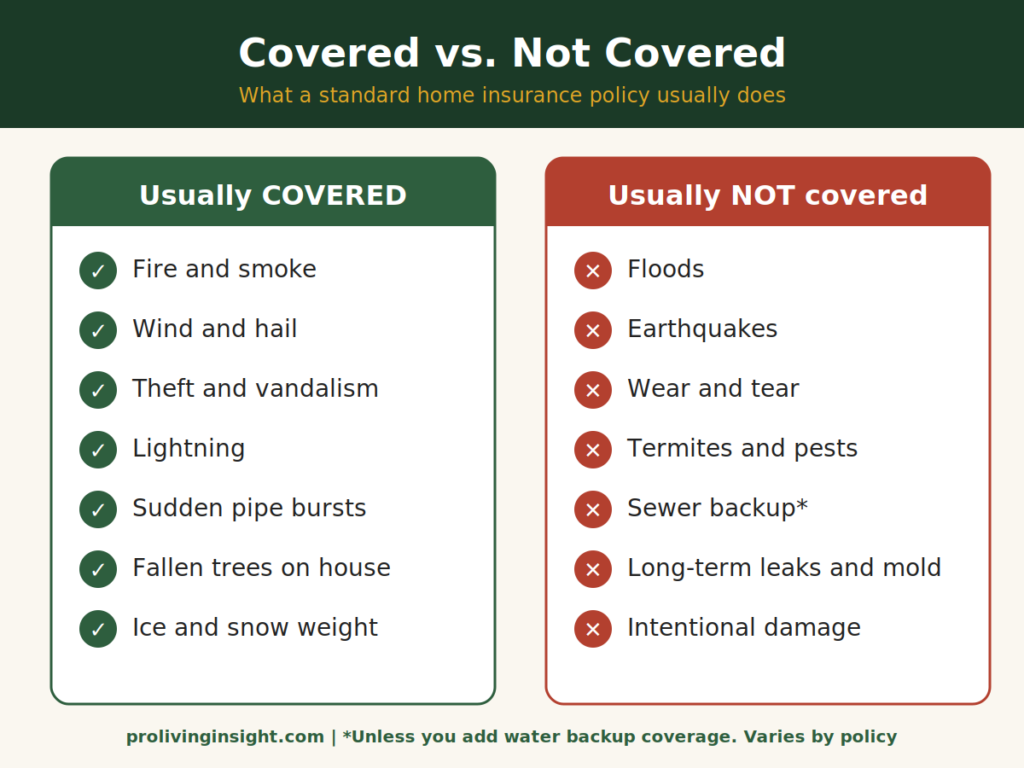
Knowing what insurance excludes can be just as valuable as knowing what it covers.
Flood Damage
Standard homeowners insurance generally does not cover flooding.
Flooding can result from rising water, overflowing rivers, heavy rainfall, storm surge, or other sources of accumulating water.
If flooding is a realistic risk where you live, separate flood insurance can provide important protection.
Earthquake Damage
Earthquake damage is generally excluded from standard homeowners policies.
Separate earthquake insurance or an appropriate endorsement may be available depending on where you live and which insurers operate in your area.
Normal Wear and Tear
Your homeowners policy is not a home-maintenance plan.
An aging roof, worn flooring, deteriorating siding, or old plumbing does not become an insurance claim simply because it needs replacement.
Insurance is generally intended to protect against covered unexpected losses rather than predictable deterioration.
Termites and Other Pests
Termites, rodents, and similar infestations are generally considered maintenance problems.
If termites slowly damage structural wood over several years, standard homeowners insurance will generally not pay for the resulting damage.
Sewer and Drain Backup
Sewer backups can cause extensive damage, especially in finished basements.
However, standard homeowners insurance may not include this risk automatically.
Water-backup coverage is often available as additional protection.
Mold and Long-Term Leaks
Coverage for moisture-related damage can be complicated. If a sudden, covered water loss leads to this type of damage, your insurer may treat the claim differently than one caused by a leak that continued for months, poor maintenance, or repeated moisture problems.
That is why it is important to address leaks and moisture issues as soon as you discover them. Delaying repairs can make the damage worse and may also affect your coverage.
Intentional Damage
Insurance generally does not cover damage that you intentionally cause.
If a homeowner deliberately damages their own property and attempts to submit the loss as an accidental claim, the situation can lead to serious coverage and legal consequences.
Business Property and Home Offices
If you operate a business from your home, your homeowners policy may provide only limited protection for business property or business-related liability.
A home-based business may require separate coverage depending on the nature and size of the operation.
Why Expensive Belongings Need Extra Attention
A common mistake is looking only at the total personal-property limit.
Imagine your policy provides substantial personal property coverage. That does not necessarily mean your expensive jewelry collection is covered for the same amount.
Certain types of property can have special sublimits.
This can become a major problem after theft or a serious house fire because homeowners may discover that their most valuable possessions were subject to a much smaller limit.
If you own expensive jewelry, artwork, collectibles, watches, or other high-value possessions, ask your insurer whether they should be separately scheduled or insured through an endorsement.
10 Real-Life Home Insurance Scenarios
| Situation | Usually Covered? | What You Should Know |
|---|---|---|
| A windstorm sends a tree onto your roof | Often yes | The covered property damage may qualify, subject to the policy and deductible |
| A pipe suddenly bursts | Often yes | Resulting water damage may be covered, while the failed pipe itself may not be |
| A washing machine leaks slowly for months | Usually no | Gradual damage is commonly treated differently from sudden accidental damage |
| A bicycle is stolen from your garage | Often yes | Personal property coverage may apply, subject to limits and conditions |
| A guest is injured on your property | Potentially | Liability or medical payments coverage may apply depending on the circumstances |
| Hail damages your siding | Often yes | Check the policy and applicable wind or hail deductible |
| A neighbor’s tree falls onto your fence | Potentially | Coverage depends on the cause and policy terms |
| Heavy rain floods your basement | Usually no under standard homeowners insurance | Flood insurance may be needed |
| A kitchen fire makes your home unlivable | Often yes | Additional living expense coverage may help with qualifying extra costs |
| Termites destroy structural wood | Usually no | Pest damage is generally excluded as a maintenance issue |
These examples describe common outcomes, not guarantees. Actual claims depend on the specific policy and circumstances.
Home Insurance Add-Ons That May Be Worth Considering
Standard homeowners insurance does not cover every risk a homeowner can face.
Water-backup coverage can help address certain losses caused by sewer backups, drain backups, or sump-pump failures when those losses are otherwise excluded.
Flood insurance can provide protection for flood damage that standard homeowners insurance generally excludes.
Homeowners in earthquake-prone regions may also consider separate earthquake coverage.
For expensive possessions, scheduled personal property can provide broader protection or higher limits for qualifying jewelry, artwork, collectibles, and other valuable items.
Equipment breakdown coverage can protect certain unexpected mechanical or electrical failures involving covered household equipment.
Service line coverage can address certain problems involving underground utility lines serving your property.
Extended replacement cost coverage can provide additional protection if rebuilding costs unexpectedly exceed the dwelling limit after a covered loss, subject to the policy terms.
Ordinance or law coverage can also become valuable after a major loss because modern building codes may require upgrades that an older home did not previously have.
Actual Cash Value vs. Replacement Cost
The way your policy values damaged property can make a major difference in the amount you receive.
Actual cash value, commonly called ACV, generally considers depreciation.
Suppose a ten-year-old sofa originally cost $1,500. A new replacement may still cost around $1,500, but the old sofa is not worth the same amount after years of use.
Under an ACV settlement, depreciation can reduce the amount paid for the item.
Replacement cost coverage works differently. It generally aims to cover the cost of replacing covered property with a comparable new item, subject to the policy’s requirements, limits, and deductible.
The difference can become significant after a major loss.
Roof claims deserve particular attention because the settlement method can vary based on the policy, roof age, condition, state requirements, and other factors.
Your Deductible Matters Too
Your deductible is the amount you are responsible for before insurance pays a covered claim.
For example, imagine you have a $2,000 deductible and a covered loss results in $12,000 of eligible damage.
If no other policy limitation applies, the insurer’s payment could be approximately $10,000 after the deductible.
Some policies use different deductibles for certain risks.
A percentage wind or hail deductible can be especially important because the deductible may be calculated from the home’s insured value rather than being a small fixed dollar amount.
How to Check What Your Policy Actually Covers
You do not need to become an insurance expert to understand the most important parts of your policy.
Start with the declarations page. This section summarizes important information such as your coverage limits and deductibles.
Next, look at your Coverage A through Coverage F amounts. These numbers tell you how much protection applies to the major coverage categories.
Then read the exclusions section. This is where you are likely to find important information about floods, earthquakes, maintenance, water backup, mold, business property, and other potential gaps.
Finally, ask your insurance agent specific questions.
Instead of asking, “Is my house fully covered?” ask something more precise, such as, “If a pipe bursts while I am away for two weeks, which damage would my policy cover?”
Specific questions make it much easier to understand what your policy actually does.
How Much Home Insurance Do You Need?
The amount of insurance you need should not be based solely on what your house would sell for today.
Market value and rebuilding cost are different measurements.
Market value includes the value of the land and can be heavily influenced by the location and local housing market.
Rebuilding cost is based on the expenses involved in reconstructing the physical house. Labor, materials, demolition, debris removal, contractor costs, and current building requirements can all influence that number.
For this reason, your dwelling coverage should be based on a realistic reconstruction-cost estimate.
Review your policy after major renovations as well.
A new addition, finished basement, major kitchen renovation, or other substantial improvement can increase the cost of rebuilding your property.
Your insurance coverage should keep pace with those changes.
5 Questions Every Homeowner Should Ask Their Insurer
Before you need to file a claim, find out how your policy handles the risks that matter most to you.
Ask whether your roof is covered at replacement cost or actual cash value. Find out what deductible applies to wind and hail damage. Confirm whether water-backup coverage is included. Ask how expensive jewelry and other valuable possessions are treated. Finally, find out how much additional living expense coverage would be available if a covered loss made your home unlivable.
These questions can expose coverage gaps while there is still time to fix them.
Frequently Asked Questions
Does home insurance cover water damage?
It can cover certain sudden and accidental water damage, such as damage caused by a covered plumbing event. Flooding, gradual leaks, and maintenance-related problems are generally treated differently. Sewer and drain backup may require additional coverage.
Does homeowners insurance cover theft outside the house?
Personal property coverage can extend to belongings away from your home under many policies. A laptop stolen while traveling, for example, may qualify. However, special limits and policy conditions can apply.
Does homeowners insurance cover roof replacement?
A roof damaged by a covered event such as certain wind or hail losses may qualify for insurance coverage. Replacing an old roof simply because it has reached the end of its useful life generally is not covered.
Does home insurance cover natural disasters?
Some natural events are commonly covered, including certain wind, hail, lightning, and fire losses.
Floods and earthquakes are generally excluded from standard homeowners insurance and may require separate coverage.
What Does Home Insurance Cover Tenants?
A landlord’s policy generally protects the building and the owner’s interests rather than the tenant’s personal belongings.
Renters typically need their own renters insurance to protect their belongings and provide personal liability coverage.
Is homeowners insurance legally required?
There is generally no universal law requiring every homeowner to carry homeowners insurance.
However, mortgage lenders commonly require insurance as a condition of the loan.
Even when there is no lender requirement, going without insurance can expose a homeowner to potentially enormous repair, replacement, and liability costs.
Final Thoughts
Home insurance is valuable protection, but it is not a maintenance contract, and it does not cover every problem that can happen to a house.
A standard policy generally protects the home’s structure, personal belongings, certain additional living expenses, and personal liability. At the same time, important risks such as flooding, earthquakes, normal deterioration, pest damage, and some water-related problems may be excluded or require additional coverage.
The biggest mistake is waiting until after a disaster to discover what your policy says.
Take a few minutes today to look at your declarations page. Check your coverage limits and deductibles. Then review the exclusions that are most relevant to your home and location.
If you have recently renovated your house, bought expensive belongings, installed a pool, finished a basement, or added another major feature, ask your insurer whether your coverage still matches your situation.
A little preparation now can make a major difference when something goes wrong.
Last reviewed: October 2026. Home insurance coverage varies by state, insurer, policy form, endorsements, limits, deductibles, and individual circumstances. This article is for general educational purposes only and is not insurance or legal advice. Review your policy and speak with a licensed insurance professional for advice about your specific situation.