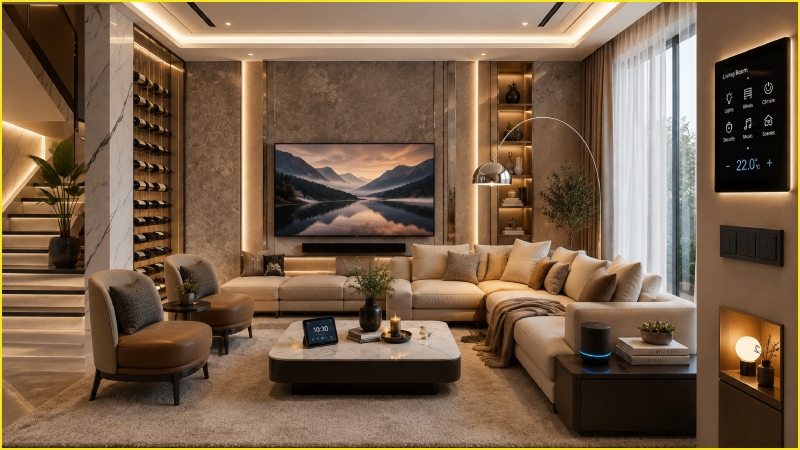
Home technology no longer has to look like technology. Decor Tech Home Devices In 2026, homeowners can add smart lighting, connected mirrors, automated blinds, digital displays, and other connected products without making a room feel like a showroom full of electronics. This is where decor tech home devices come in.
The concept is simple: combine useful smart-home features with designs that naturally complement your interior.
Instead of hiding every device behind furniture, homeowners can choose technology that contributes to the room’s appearance. A mirror can provide adjustable lighting. A decorative display can showcase artwork or family photos. Smart lighting can change the mood of an entire room without replacing furniture.
The trend reflects a wider shift in smart-home technology. AI is becoming more useful for everyday control, while standards such as Matter are improving communication between compatible products and ecosystems.
This guide explains what decor tech means, the most useful device categories, what to consider before buying, common mistakes to avoid, and the smart-home trends shaping interiors in 2026.
What Are Decor Tech Home Devices?
Decor tech home devices are connected products designed to perform a practical function while fitting naturally into a home’s interior design.
Traditional smart-home products often put technology first. Decor tech takes a different approach. The device needs to work effectively, but its appearance and integration with the room matter too.
Common examples include smart lighting with attractive fixtures and controls, LED bathroom mirrors with adjustable lighting, digital art and photo displays, motorized curtains and blinds, decorative smart speakers, connected switches and dimmers, and smart ambiance devices.
It is important to understand that decor tech is not a formal technical standard. It is a descriptive term for smart products where technology and interior design work together.
A beautifully designed smart dimmer can qualify as decor tech even if it does not use artificial intelligence.
That makes the category broader than simply calling something an “AI home device.”
Why Is Decor Tech Gaining Attention in 2026?
Several developments are bringing connected technology closer to everyday interior design.
AI Is Becoming More Practical
Artificial intelligence is moving beyond novelty features in smart homes.
Smart-home platforms are increasingly using AI to understand natural-language requests, simplify automation, interpret information from connected devices, and make everyday controls easier.
Google’s smart-home ecosystem is a clear example. In 2026, Google expanded Gemini for Home with more natural conversations, continued-conversation capabilities, broader automation features, and a new Google Home Speaker built specifically for Gemini for Home.
This does not mean every decor tech product needs its own AI assistant.
In many cases, AI works behind the scenes as part of the wider smart-home ecosystem. The bigger change is that controlling connected devices is becoming more conversational and less dependent on rigid commands.
Matter Is Improving Smart-Home Interoperability
Matter remains one of the most important developments in connected-home technology.
The standard is designed to make supported smart-home devices easier to use across compatible ecosystems. However, Matter does not guarantee that every feature will work identically across every platform.
That distinction is important when shopping for decor tech.
In June 2026, the Connectivity Standards Alliance released Matter 1.6, an update focused on easier device setup, better multi-ecosystem experiences, and improved context-driven control.
Before buying a Matter-compatible product, check the exact Matter features supported, compatible smart-home platforms, required hubs or controllers, available automation features, and whether the features you want work across your chosen ecosystem.
Matter can make a smart home easier to manage, but compatibility still deserves attention.
Technology Is Becoming Less Visually Intrusive
Not every room needs a large screen or an obvious electronic gadget.
Modern products give homeowners more ways to integrate technology into furniture, walls, mirrors, lighting, and other decorative elements.
The goal is not necessarily to make a home look futuristic.
Instead, the better approach is to make technology feel like a natural part of the room.
That balance between convenience and visual simplicity is one of the strongest ideas behind decor-focused smart products.
Top Categories of Decor Tech Home Devices
Connected Lighting
Connected lighting is one of the easiest ways to bring technology into your home decor.
LED bulbs, light strips, decorative lamps, wall fixtures, and app-controlled dimmers can adjust brightness, color temperature, or color, depending on the product.
A simple lighting routine can create different scenes for different activities. You can use bright illumination for work, warm tones for relaxing, soft lighting for movie nights, scheduled lighting for mornings, and motion-activated lights for hallways.
The biggest advantage is flexibility.
You can completely change the mood of a room without replacing furniture or repainting the walls.
In 2026, decorative lighting is also moving toward more sculptural and human-centered designs. Interior-design trends increasingly treat lighting as an artistic feature, with warmer tones, natural materials, and softer forms becoming more prominent.
Smart Mirrors and Connected Displays
Smart mirrors combine a familiar decorative feature with connected lighting and, on some models, additional digital functions.
Basic models may focus mainly on adjustable LED lighting. More advanced products can include touch controls, displays, sensors, speakers, or app connectivity.
It is important to distinguish between a simple LED mirror and a genuinely connected smart mirror.
A mirror with adjustable lighting is not automatically an AI-powered device.
Before buying one, consider lighting controls, color-temperature adjustment, motion sensing, app support, voice-assistant compatibility, screen features, installation requirements, and appropriate bathroom safety ratings.
For bathroom installations, electrical safety and the manufacturer’s installation requirements should come before appearance.
Digital Art Frames
Digital art frames can turn an ordinary wall into a changing display.
Depending on the product, you may be able to display artwork, family photographs, illustrations, or other digital content.
This can be useful for homeowners who want flexible wall decor without constantly purchasing new prints.
Before buying a digital art frame, consider screen appearance, brightness, viewing angle, power requirements, storage options, artwork licensing, and subscription costs.
The display should look attractive even when you are not actively interacting with its smart features.
Smart Curtains and Blinds
Motorized curtains and blinds are another practical form of decor tech.
Depending on the system, they can open or close according to schedules, sunlight conditions, or automation routines.
For example, you could schedule blinds to open in the morning and close later in the day. Compatible systems can also connect window coverings with lighting and other home routines.
Automated window coverings may also help manage sunlight and indoor comfort.
However, actual energy savings vary according to the home’s climate, windows, installation, materials, automation settings, and household behavior.
Do not assume that every motorized blind will produce the same energy results.
Smart Speakers That Look Like Decor
Smart speakers have traditionally looked like obvious electronic devices.
Newer designs increasingly focus on materials, shapes, and finishes that can sit comfortably alongside books, lamps, plants, and other decorative objects.
This category is becoming more interesting in 2026 as AI moves into home speakers.
Google’s new Google Home Speaker, announced in June 2026, was built around Gemini for Home and focuses on more natural interaction with the smart home.
When choosing a decorative smart speaker, check the supported voice assistant, smart-home ecosystem, audio quality, connectivity, privacy controls, and software support.
A beautiful speaker becomes much more useful when it also works with the devices you already own.
Smart Switches and Dimmers
A smart switch may not look as exciting as a digital art display, but it can have a major impact on everyday convenience.
A well-designed switch can control existing lights while adding scheduling, scenes, remote control, automation, and voice control.
This can also be a practical way to make existing lighting smarter without replacing every bulb.
Hardwired switches may require professional installation. Always follow the manufacturer’s instructions and local electrical requirements.
Smart Ambiance Devices
Connected fragrance diffusers and other ambiance products combine sensory experiences with automation.
For example, a homeowner could create an evening routine that lowers the lights and activates an ambiance device at the same time.
These products require extra care around children and pets.
Fragrance ingredients can affect animals differently, so always check the manufacturer’s safety guidance before using these products around pets.
Decor Tech Options by Budget
Budget-Friendly Options
If you’re building a connected home on a limited budget, start with simple upgrades that offer noticeable benefits without major installation.
Connected LED bulbs and light strips can refresh a room’s atmosphere while keeping installation simple.
Wi-Fi plugs can automate compatible lamps and everyday appliances with minimal effort.
Automated dimmer switches can give you better control over existing lighting while preserving the room’s original design.
These affordable upgrades can improve convenience and ambiance without requiring a complete home renovation.
Mid-Range Options
With a larger budget, you can choose products that become part of the room’s design.
Digital art displays can replace static wall decoration with flexible digital content.
Motorized blinds can improve convenience and become part of scheduled home routines.
Higher-quality smart lighting fixtures can combine decorative value with automation.
Premium Options
Premium decor tech works best when technology is integrated into the architecture rather than simply placed on a shelf.
Examples include high-quality smart mirrors, integrated lighting systems, designer smart switches, motorized window treatments, and professionally installed control systems.
At this level, installation quality can matter almost as much as the device itself.
Benefits of Adding Decor Tech to Your Home
Better Ambiance
Lighting is one of the simplest ways to change how a room feels.
A warm evening scene can make a living room feel more relaxed, while brighter task lighting can make the same room more practical during the day.
The furniture stays the same.
The atmosphere changes.
More Convenience
Automation can remove small repetitive tasks from your daily routine.
Lights can follow schedules. Blinds can respond to routines. Compatible devices can activate together through scenes.
The best automation is often the kind you stop noticing because it simply works.
Better Integration
Modern smart-home systems are moving toward greater interoperability.
Matter is an important part of this development. Its June 2026 Matter 1.6 release specifically focused on easier setup, multi-ecosystem experiences, and better device coordination.
However, buyers should still verify individual product compatibility before purchasing.
Potential Energy Benefits
Smart controls can help reduce unnecessary use by automating lights, window coverings, and other compatible equipment.
However, energy savings are not identical for every household.
Actual results can depend on device type, installation, climate, household behavior, automation settings, and how frequently the equipment is used.
For that reason, avoid relying on a generic energy-saving percentage unless it comes from testing that applies directly to the product or system.
A More Cohesive Interior
Traditional smart-home equipment can sometimes make a room feel cluttered.
Decor-focused technology can reduce that problem by making the device itself part of the interior.
That is the real appeal of decor tech: technology can provide useful functionality without becoming the visual focus of the room.
How to Choose the Right Decor Tech Devices
Check Compatibility First
Do not buy a device simply because it looks good.
Check whether it works with the platform you already use, such as Google Home, Alexa, or Apple Home.
If Matter support is advertised, verify exactly which Matter features the product supports.
Compatibility should come before appearance.
Consider the Total Cost
The purchase price is not necessarily the final cost.
Before buying, consider installation, hubs or controllers, subscription fees, replacement parts, energy consumption, professional setup, and future compatibility.
A cheaper device can become more expensive if it requires several additional accessories or ongoing subscriptions.
Match the Device to Your Interior
Technology should complement the room instead of fighting with it.
Warm metallic finishes can work well with traditional or transitional interiors. Matte black can suit modern spaces, while frameless products can create a quieter minimalist appearance.
Do not choose a product simply because it has impressive specifications.
Consider how it will look when it is sitting in the room every day.
Think About Installation
Smart bulbs and plugs are usually straightforward DIY upgrades.
Hardwired switches, large mirrors, motorized blinds, and integrated systems may require electrical or professional installation.
Always follow the manufacturer’s installation requirements and use qualified professionals where necessary.
Common Decor Tech Mistakes to Avoid
1. Buying Without Checking Compatibility
A product may support one ecosystem but not another.
Check compatibility before purchasing, especially if you already have several smart-home products.
2. Assuming Matter Solves Everything
Matter can improve interoperability, but it does not mean every feature works identically across every platform.
Always check the exact product specifications.
3. Choosing Appearance Over Function
A beautiful device that performs poorly is still a bad purchase.
Look for a balance between design, reliability, useful features, and long-term support.
4. Ignoring Privacy
Cameras, microphones, occupancy sensors, and connected displays can collect information about how a home is used.
Review privacy controls before installation.
Useful features to look for can include physical camera shutters, local processing where available, clear data policies, and strong account-security options.
5. Ignoring Software Updates
Connected devices require ongoing software support.
Firmware updates can improve functionality and address security issues.
Before buying an unfamiliar product, check whether the manufacturer provides regular software support and maintains its devices over time.
6. Over-Automating the Home
More automation is not always better.
If lights constantly turn on at the wrong time or blinds close when you do not want them to, technology can become frustrating instead of helpful.
Start with a few useful routines and expand gradually.
Decor Tech Trends to Watch in 2026
AI-Enhanced Home Control
AI is becoming a larger part of smart-home platforms.
The change is not simply about adding AI labels to products.
The more important development is the move toward natural interaction.
Instead of memorizing exact commands, homeowners can increasingly describe what they want in everyday language.
Google’s 2026 updates to Gemini for Home demonstrate this direction, including conversational control, continued conversation, home automation, and AI-powered assistance.
This could make smart homes easier for people who previously found automation complicated.
More Interoperability
Matter continues to evolve as connected-home technology develops.
Matter 1.6, released in June 2026, added improvements around device setup, multi-ecosystem management, and context-driven control.
Its long-term importance will depend on how widely manufacturers support the standard and how consistently different platforms implement its features.
Smarter Energy Management
Connected homes are expanding beyond basic lights and speakers.
Energy management can include appliances, EV charging, heat pumps, solar systems, batteries, and other equipment.
As more household systems become connected, homeowners may increasingly manage comfort, convenience, and energy use through integrated automation.
This is an important direction because the smart home is gradually becoming a connected system rather than a collection of individual gadgets.
Technology That Blends Into the Home
The future of decor tech is not necessarily about adding more screens.
In many rooms, the better solution is technology that becomes less visually dominant.
Smart controls can disappear into walls. Lighting can become architectural. Displays can look like artwork. Sensors can operate quietly in the background.
Current interior-design trends are also moving toward sculptural lighting, natural materials, softer forms, and more human-centered spaces. That makes visually integrated smart lighting particularly relevant to the decor-tech conversation.
The result is a home where technology supports the design instead of competing with it.
FAQs About Decor Tech Home Devices
Are Decor Tech Devices Expensive to Maintain?
Not necessarily.
Basic smart bulbs, plugs, and switches generally have simple maintenance requirements.
More advanced products may involve subscriptions, replacement components, professional servicing, or software-dependent features.
Always consider long-term costs before purchasing premium equipment.
Do I Need a Smart Hub?
Not always.
Some devices connect directly through Wi-Fi, Bluetooth, or other supported technologies, while other setups benefit from a hub or controller.
The right choice depends on the devices you plan to connect and the smart-home ecosystem you use.
Can Decor Tech Devices Work Without Wi-Fi?
It depends on the device.
Some products retain basic physical controls when the internet is unavailable.
Remote control, cloud services, voice assistants, and certain automations may stop working.
Always check the manufacturer’s information about offline functionality.
Are Decor Tech Home Devices Safe for Children and Pets?
Many are safe when installed and used correctly.
However, products containing cords, heat, glass, batteries, fragrances, cameras, or small removable parts require additional care.
For fragrance products, check whether the ingredients are appropriate for pets before using them around animals.
What’s the Difference Between Smart-Decor Tech Home Devices?
Smart-home devices are primarily defined by their connected functions.
Decor tech places greater emphasis on appearance and integration with the interior.
For example, a security camera may be a smart-home device, while a beautifully designed connected lamp can be considered decor tech.
Some products can belong to both categories.
Final Thoughts
Decor tech home devices show how smart technology is changing the way we think about interior design.
The goal is not to fill every room with gadgets.
A better approach is to choose technology that solves a real problem while fitting naturally into your home.
Start with one meaningful upgrade.
Smart lighting can change the atmosphere of a room. Motorized blinds can simplify daily routines. A well-designed mirror can combine useful lighting with a clean visual appearance. A decorative smart speaker can provide voice control without looking out of place.
As AI, interoperability, and connected energy systems continue developing in 2026, smart homes are becoming less about individual gadgets and more about how different technologies work together.
The best decor tech is not necessarily the device with the longest feature list.
It is the device that works reliably, looks right, and makes your home easier to live in.